How AI Metadata Improves Your Exported Documents
Introduction
When exporting documents, most people focus only on visible content — text, images, tables, and formatting.
But behind every professional document lies something just as important: metadata.
AI-generated metadata enhances document organization, improves searchability, and strengthens SEO performance. It transforms static files into intelligent, structured digital assets.
Here's how AI metadata makes your exported documents significantly more powerful.
What Is Document Metadata?
Metadata is hidden structured information embedded inside a file.
Common metadata fields include:
While users don't see this information directly, search engines, operating systems, and document management systems rely on it heavily.
Without proper metadata, even well-written documents can become difficult to locate or categorize.
1. Automatic Smart Titles
File names like "final-version2.docx" create confusion.
AI Advantage
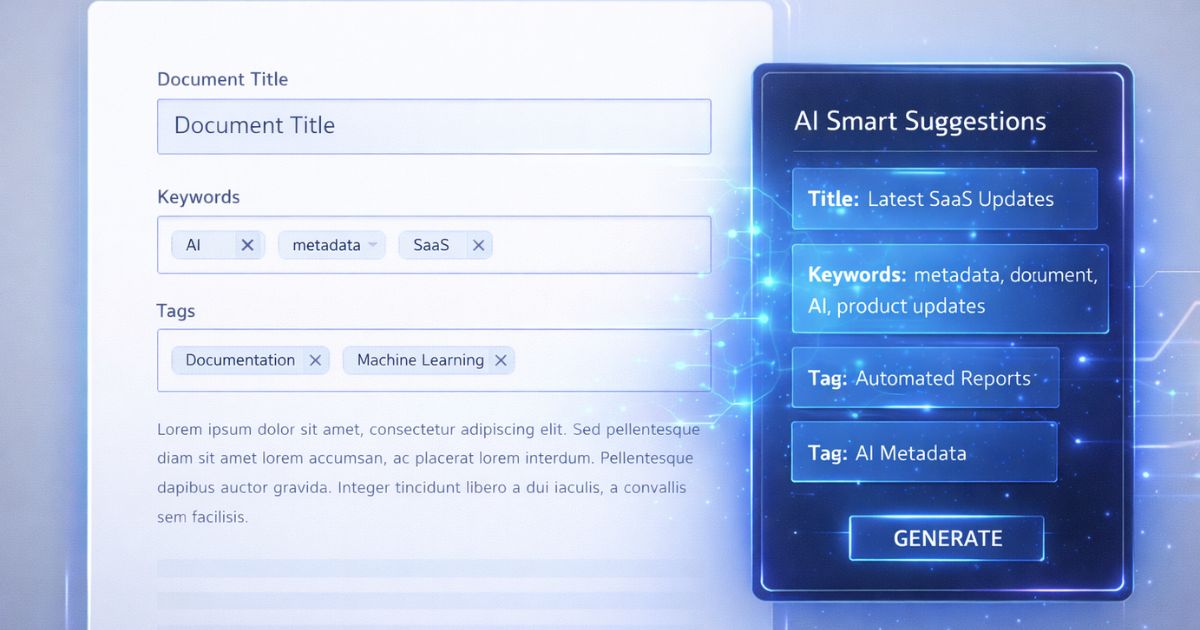
AI analyzes the document content and generates:
This ensures every exported file has a meaningful identity from the moment it's created.
2. Intelligent Keyword Extraction
Search performance depends on keywords.
AI scans the full content of the document to detect:
These keywords are embedded into the document's metadata, improving:
This makes documents easier to discover later.
3. Better Organization for Teams
In large teams or growing businesses, file chaos becomes a real problem.
AI can automatically assign:
This structured classification reduces manual tagging and prevents organizational inconsistencies.
4. Stronger SEO for Published Documents
If you publish PDFs or reports online, metadata directly influences search visibility.
Search engines analyze:
AI ensures metadata aligns perfectly with document content, increasing the likelihood of ranking when indexed.
5. Reduced Human Error
Manual metadata entry leads to:
AI eliminates these errors by standardizing metadata generation across all exported files.
Consistency improves both usability and professionalism.
The Real Impact
AI metadata optimization delivers:
What seems invisible at first glance becomes a powerful structural advantage.
Conclusion
Content is what readers see.
Metadata is what systems understand.
By using AI-generated metadata, exported documents become more than static files — they become searchable, structured, and strategically optimized assets.
Smart content deserves smart metadata.