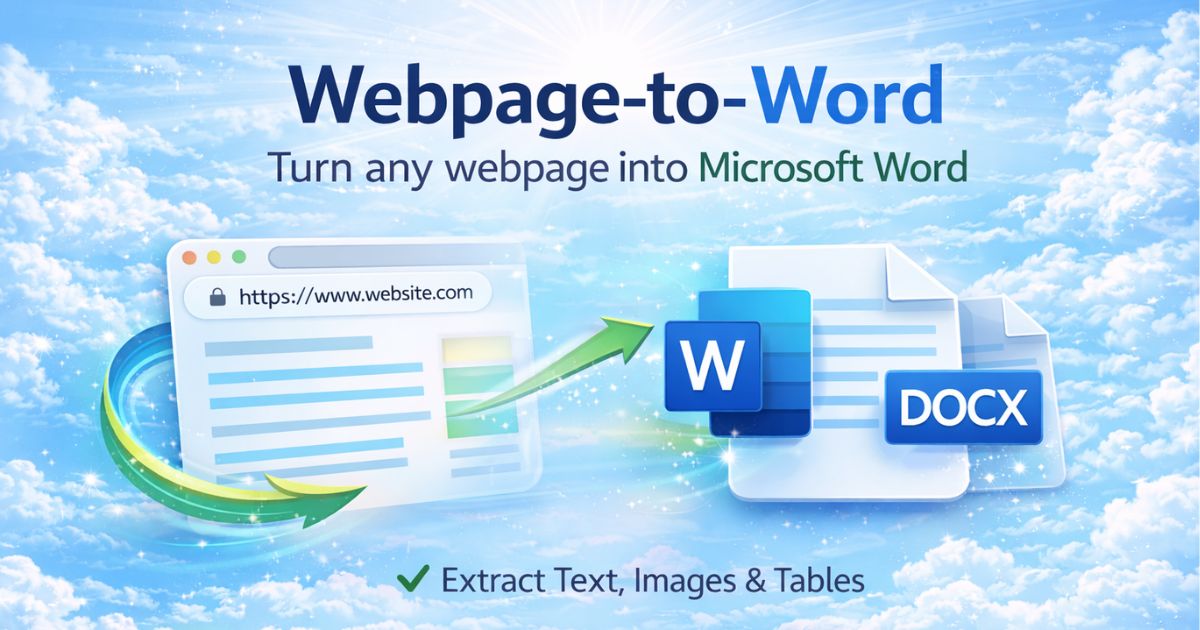
Convierte cualquier página web a Word editable (.docx)

    Extrae contenido estructurado de cualquier sitio web y transfórmalo en un documento Microsoft Word totalmente editable — formato limpio, encabezados conservados y sin desorden.

    Convierte esta página a Word

    Pega cualquier URL — sin registro ni instalación.

    Conversión instantánea
    Sin datos almacenados

    ¿Prefieres convertir sin salir de la página que estás leyendo?

    • Convert while you browse — no tab switching
    • One click from any page
    • No copy/paste, no manual cleanup
    • Lives in your toolbar, always one click away
    • Faster than the web app for everyday use
    convert webpage to word document

    ¿Por qué convertir páginas web a Word?

    Mientras que los PDF son ideales para archivar, los documentos Word son esenciales para editar, colaborar y reutilizar profesionalmente. Investigadores, equipos de contenido, profesionales del derecho y equipos corporativos a menudo necesitan documentos estructurados y editables en lugar de archivos estáticos.

    Page2Doc extrae de forma inteligente la estructura semántica de una página — encabezados, listas, tablas, imágenes — y la convierte en un archivo .docx con formato adecuado.

    Page2Doc asigna cada nivel de encabezado HTML a su equivalente de Word: un <h1> se convierte en un estilo «Heading 1» real, y así sucesivamente hasta <h6>. Esto habilita el panel de navegación, las tablas de contenido automáticas y la vista de esquema de Word.

    El archivo .docx generado es un paquete Open XML estándar que suele abrirse en Microsoft Word, Google Docs y LibreOffice Writer. El formato puede variar según la aplicación, pero Word es la opción adecuada frente al PDF cuando necesitas editar, comentar, seguir cambios o combinar contenido.

    Flujos de trabajo para los que se creó la conversión a Word

    Los flujos de investigación se benefician de conservar la jerarquía de encabezados: puedes saltar directamente a «Metodología» o «Resultados» en el panel de navegación en lugar de recorrer un bloque de texto sin estructura.

    Los equipos jurídicos necesitan documentos compatibles con comentarios y control de cambios. Una normativa, un resumen de expediente o un registro público convertido puede anotarse directamente, sin tener que volver a escribirlo.

    Los flujos empresariales y de consultoría suelen partir de una página web para preparar una propuesta, auditoría o informe interno. Convertirla a Word evita la transcripción manual.

    En educación, estudiantes y profesores pueden anotar una fuente o combinar varios artículos en un dossier de lectura. Un documento editable resulta más útil que una página que solo se puede consultar en línea.

    Los periodistas pueden conservar una fuente como documento editable y fechado, con su estructura de encabezados intacta. El archivo permanece disponible aunque la página original cambie o desaparezca.

    Los equipos de marketing pueden convertir una landing page, una descripción de producto o una nota de prensa en un borrador estructurado para reutilizarlo sin limpiar estilos pegados.

    Los desarrolladores pueden pasar la documentación de una biblioteca a Word para adjuntarla a un documento de diseño interno o compartirla con alguien sin acceso al sitio original. Los bloques de código y los encabezados se mantienen.

    Errores habituales

    Un error habitual es esperar una reproducción visual píxel por píxel. Page2Doc extrae estructura semántica — encabezados, tablas y listas — en lugar de fuentes, colores y posiciones exactas, porque esa estructura hace editable el resultado. Espera también a que la página termine de cargar.

    Buena práctica

    Para reducir retoques, mantén activado «Eliminar anuncios y desorden» en artículos y blogs, pero desactívalo en documentación cuya barra lateral o tabla de contenido quieras conservar.

    Cómo funciona el flujo de conversión

    1. 1

      Fetch the Page

      Page2Doc requests the URL you provide using a headless browser that waits for the page's own JavaScript to finish rendering, so single-page apps and JS-heavy sites are captured fully loaded, not as a blank shell.

    2. 2

      Clean the Content

      Scripts, tracking pixels, ad containers, cookie banners, navigation menus, and sidebars are stripped before anything else happens, leaving the actual article content.

    3. 3

      Extract the Structure

      The cleaned HTML is parsed into a structured document model — headings keep their level (H1–H6), and paragraphs, lists, tables, and images are identified individually rather than captured as one flat block of text.

    4. 4

      Resolve Images

      Each image referenced in the content is fetched, resized, and re-encoded, so the final document stays a reasonable file size instead of embedding oversized originals.

    5. 5

      Generate the Word Document

      The structured document is converted into a real .docx file: HTML headings become genuine Word "Heading 1–6" styles, HTML tables become native Word tables, and images are embedded directly in the file — not linked externally.

    6. 6

      Download

      Your browser downloads the finished .docx immediately. The web app doesn't persist the source page or the generated file after your download completes.

    Cómo convertir una página web a Word en 3 pasos

    1

    Instala la extensión Page2Doc para Chrome

    Ve a la Chrome Web Store e instala la extensión Page2Doc con un solo clic. No se requiere cuenta ni registro.

    2

    Abre la página web que deseas convertir

    Navega a cualquier artículo, entrada de blog, página de documentación o contenido web que quieras guardar como un documento Word editable.

    3

    Haz clic en Page2Doc y selecciona Word (.docx)

    Haz clic en el icono de Page2Doc en la barra de herramientas, elige Word/DOCX como formato de salida y descarga tu documento completamente editable con encabezados, tablas e imágenes conservados.

    ¿Qué hace diferente a Page2Doc?

    Editable .docx — not a locked, flattened copy
    Real Word heading styles (Heading 1–6), not bold text
    HTML tables become native, editable Word tables
    Images are resized and embedded, not linked or missing
    Ads, navigation, and clutter removed automatically
    Seconds, not minutes of manual cleanup
    No login required for the free tier; URL fetched fresh, not from your session
    Works from any device — no desktop software required

    Casos de uso ideales

    Redacción de borradores
    Reutilización de contenido
    Preparación de documentos
    Archivo de conocimiento
    Edición de documentación
    Compilación desde fuentes web

    Page2Doc vs Copiar y pegar vs Conversores en línea

    CaracterísticaPage2DocCopiar y pegarConversores en línea
    Estructura limpia de encabezados
    Conserva las tablas
    Elimina anuncios y desorden
    Procesamiento local (privacidad)
    Conversión con un clic
    Sin necesidad de subir archivos
    Salida editable en .docx
    Formato consistente

    Aplicación web o extensión de Chrome: ¿cuál debes usar?

    Web App

    Best when you already have the URL in hand — pasting a link into a batch of pages, converting a page you found in someone else's message, or working from a device where you can't install a browser extension.

    Chrome Extension

    Best while you're already reading — one click from the toolbar converts the exact page you're looking at, with no tab-switching, no copying a URL, and no leaving the page you're on.

    The two aren't competing tools — they cover different moments. The web app is for converting pages you're sent or need to process in bulk; the extension is for converting pages you're already browsing. Most regular users end up using both.

    Preguntas frecuentes

    Documentación

    Quick Start

    1. Paste a URL into the converter above, or install the Chrome extension for one-click conversion from any page you're browsing.
    2. Choose Word (.docx) as the output format — it's selected by default on this page.
    3. Click Convert. Your browser downloads the .docx file automatically once conversion finishes, typically within a few seconds.

    Best Practices

    • Keep "Remove Ads & Clutter" on for articles and blog posts; turn it off for documentation pages where the sidebar or table of contents matters.
    • Let the page finish loading in your own browser before converting — the extension captures exactly what's already rendered.
    • For very long pages, expect a slightly longer conversion time — image resolution is the main variable.

    Limitations

    • Content behind a login wall isn't reachable from the web app — use the Chrome extension instead, since it works from your already-authenticated tab.
    • Content inside an <iframe> (embedded widgets, some embedded PDFs) is not followed, for the same reason browsers restrict cross-frame access.
    • Visual design (exact fonts, colors, pixel layout) is not preserved — only semantic structure is, which is what makes the result editable.

    Troubleshooting

    The download didn't start.
    Check that your browser isn't blocking the download or pop-up; try the request again — a transient network timeout is the most common cause.
    An image or table is missing from the output.
    The source may load that content via JavaScript after the initial page load, or it may sit inside an iframe. Try the Chrome extension, which converts the page as your browser has already rendered it.
    I hit the daily free limit.
    Free conversions reset daily. Upgrading removes the daily cap — the upgrade prompt shows your reset time and a direct link.

    Supported Websites

    Page2Doc works on any publicly accessible webpage — news articles, blog posts, documentation sites, Wikipedia, and JavaScript-rendered single-page apps. Pages that require a login are only reachable via the Chrome extension, not the web app.

    Output Quality

    Output quality depends on how well-structured the source page is: pages that use real HTML headings, lists, and tables convert cleanly; pages built entirely from styled <div> soup (no semantic HTML) convert with less structure, since there's less structure to extract in the first place.

    API Example

    Every format — PDF, Word, and Excel — uses the same authenticated conversion API, so switching a request from PDF to Word is a one-word change:

    POST https://page2doc.com/api/chatgpt/convert
    Authorization: Bearer YOUR_API_KEY
    Content-Type: application/json
    
    {
      "url": "https://example.com/article",
      "format": "docx"
    }
    
    # Response (202 Accepted — poll the job until it completes):
    {
      "jobId": "job_abc123",
      "status": "queued",
      "estimatedTime": 15
    }
    View full API reference →

    Herramientas de conversión relacionadas

    Continue Your Workflow

    What most people do next with this result.

    Herramientas populares de conversión a Word

    Herramientas específicas para distintos contenidos y usos

    Empieza a convertir a Word al instante

    Añadir a Chrome — Gratis